


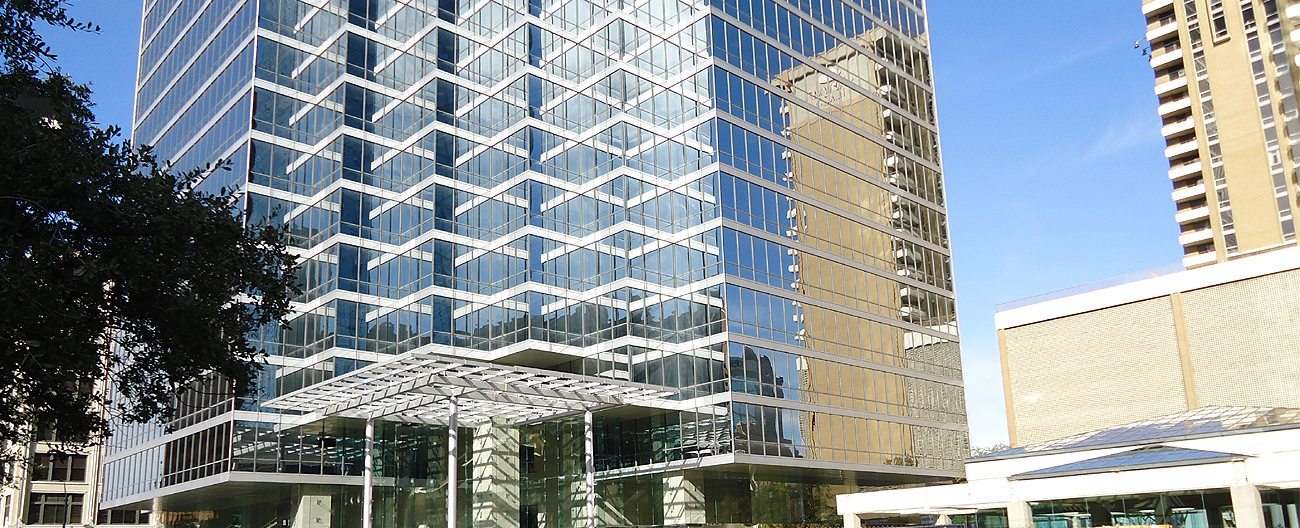
Buried Band-Aid: Plaza Deck Expansion Joint Sealing
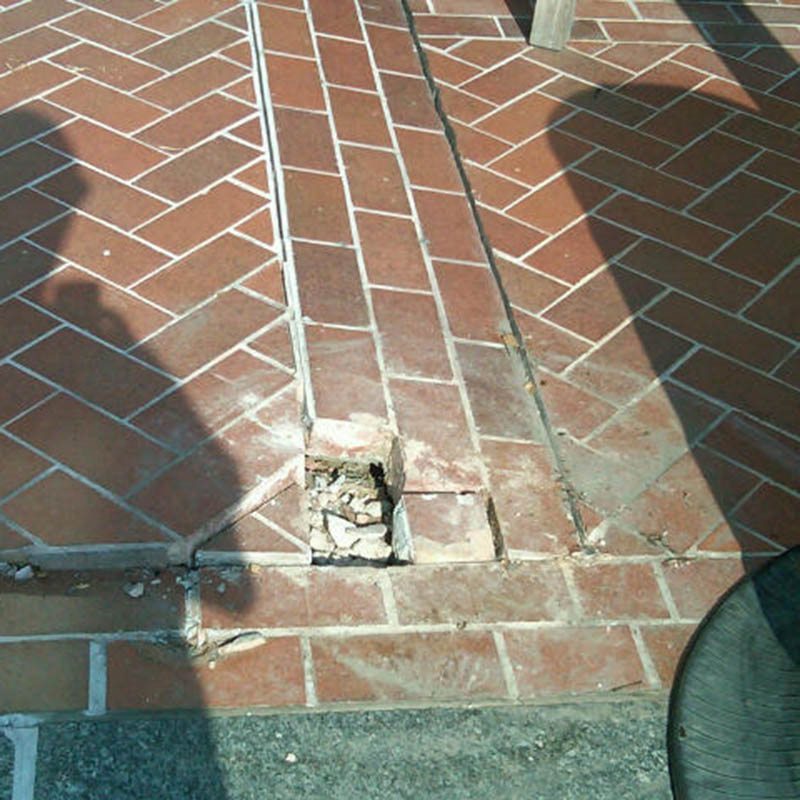
Sweeping Plaza Deck Expansion Joints Under the Rug–The hidden pitfalls of “buried band-aid” joint sealing solutions.
Plaza deck, or waterproofed split-slab, expansion joint sealing is serious business.
Usually over occupied space, plaza decks are actually heavy duty roofs. Until the emergence of the first purpose-designed, watertight system about 30 years ago (Migutan by Migua), designers were left with the ineffective option of a buried looped membrane, “band-aid” approach to addressing these critical joints.
Buried-membrane options offered today are nothing more than a throwback to band-aid solutions for plaza and roof deck joint sealing. These out-dated solutions in no way respect an owner’s desire for durability nor do they honor the reputation of designers who research, engineer, detail and specify solutions in the long-term interest of building owners.
Migutan, and the other FP (For Plaza) systems from EMSEAL, are watertight, plaza, roof deck, and roadway joint systems specifically engineered to address the shortcomings of buried, sheet-membrane joint treatments in hardscaped split-slab design that pre-date it by decades.
Migutan in action:
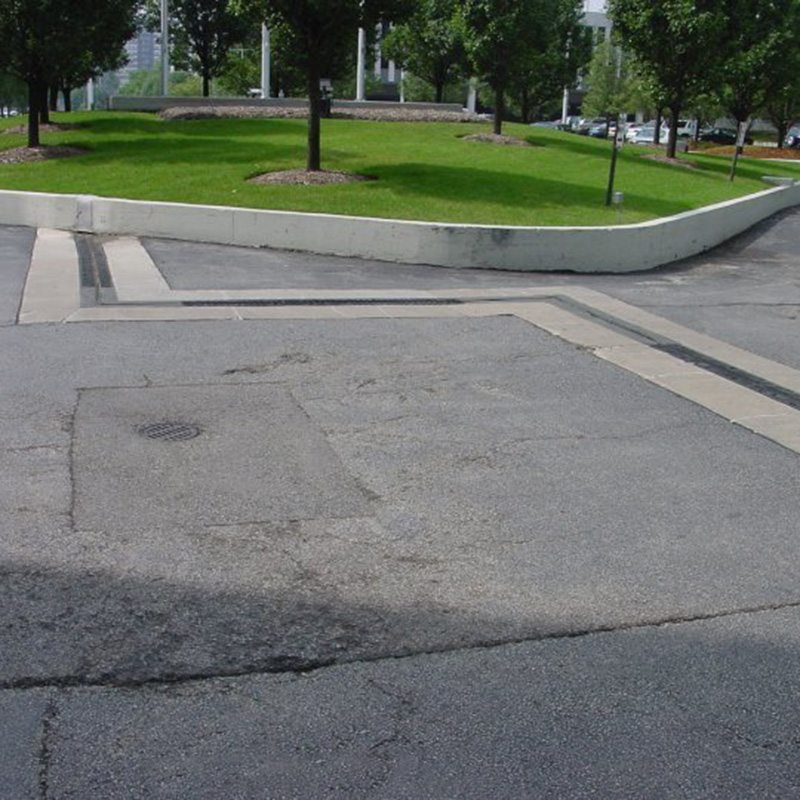
Before: Leaking joints not integrated into waterproofing membrane.

During: Migutan-FP joints totally integrated into deck waterproofing membrane.
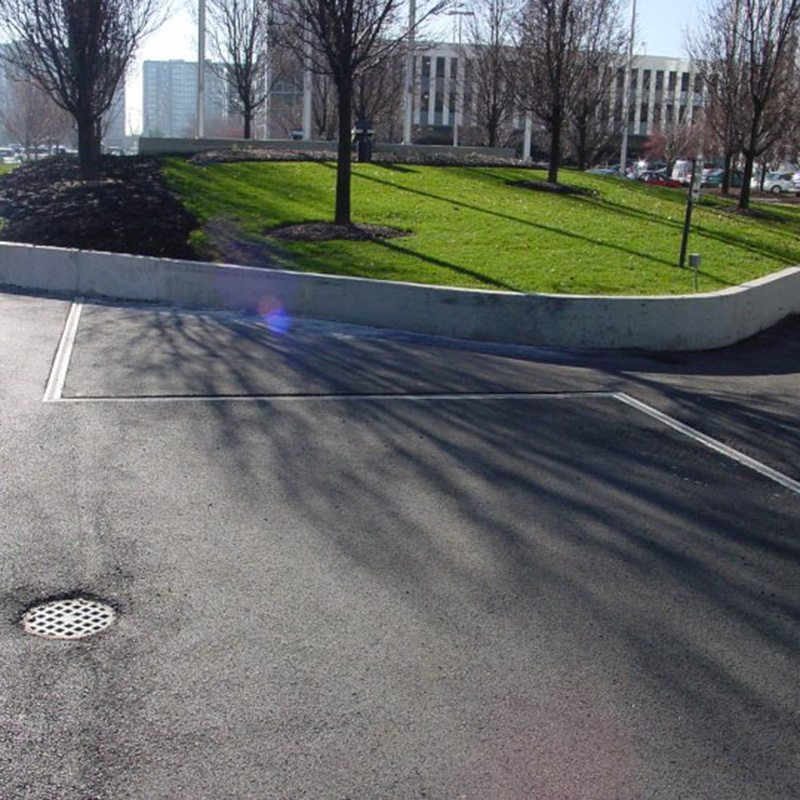
After: Finished planters and roadway surface over watertight plaza deck.
Specification of the an FP system results in attention to detail and quality assurance appropriate to the achieving watertightness in this critical application. It is precisely this lack of attention on many projects that causes joints to leak prematurely and result in exorbitant costs of inspection, investigation, repair and replacement of buried systems. These direct costs are compounded by the costs of disruption of operations of the affected facility.
The list of criteria on which band-aids (buried-EPDM-membrane type products) do not match the FP-System specification for plaza deck sealing is lengthy. Fundamentally, however, the buried membrane approach does not meet split-slab design philosophy in the following ways:
- Principle of Operation
- Composition
- Track Record
1) DESIGN PHILOSOPHY AND PRINCIPLE OF OPERATION: Buried, Band-Aid Approach vs. Static Membrane Integration with Positively-Anchored, Purpose-Designed, Repair-Accessible, Movement Gland
Plaza and roof deck waterproofing involves a waterproofing membrane applied to a structural deck. These components are covered with some sort of topping. The topping is porous by design and allows water to reach the membrane on the structural slab where it is managed to drains. When expansion joints are necessary through plaza or roof decks they must be waterproofed using a method and material that accommodates movement while reducing or eliminating the stresses that will cause a buried membrane to fail.
FP-System Design Philosophy
The FP-System design philosophy recognizes the need for the joint system to have a static integration with the deck waterproofing membrane. In addition the specified design recognizes the need to have a purpose-designed, heavy-duty seal to accommodate movement at the joint that is integrated with the deck-waterproofing tie-in but that is accessible for repair, if necessary, without disruption of the topping system.
Furthermore, using retainer legs matched to the topping slab thickness, the FP-Systems project upward from the structural slab to the level of the top of the wearing course. This means that the topping slab or pavers are separated at the wearing surface and sit adjacent to the seal that handles the structural movement. This prevents random cracking and buckling of the wear course materials.
Buckled pavers over buried “band-aid” waterproofing at structural expansion joints are unsightly, dangerous and costly to repair.
Buried Membrane Design Philosophy
The design philosophy that characterizes the “buried, band-aid” approach involves placing a strip of reinforced membrane over joints and adhering it to the deck or to the waterproofing deck membrane. The problem with this approach is that the accumulation of water combined with freeze/thaw cycles, as well as flex fatigue from movement, compounded by abrasion between topping and buried components, results in the inevitable rupture of the buried “band-aid”.
Furthermore, structural movement that occurs at the expansion joint in the structural slab is referred to the surface where the pavers or topping slab are usually inadequately isolated to accommodate movement. The result is buckled pavers that are a safety hazard or unsightly random cracking in concrete overlays.
Remediation of failures of these buried systems involves nothing short of the removal of the entire surrounding topping system to expose the membrane. Because the location of roof and plaza decks is over occupied, often sensitive interior space, the disruption to tenant operations of this type of remediation usually renders the space below unusable for the duration of the repair or replacement. (Incidentally, EMSEAL conducts a considerable remediation business using the FP-Systems for precisely this type of failure in buried, “band-aid” plaza deck joint sealing attempts. In medical facilities, like for example the MRI unit at Vanderbilt University Hospital, the impact of failure of the buried “band-aid” system was not only huge in respect of equipment damaged, but facility use was severely disrupted during repair. The repair was made using the Migutan-FP system to impart watertightness to the structure).
2) COMPOSITION
FP-System Composition
FP-Systems incorporate corrosion-free, aluminum and stainless-steel mounting rails that are mechanically secured to the structural slab to provide a positive anchoring of the waterproofing components. The metal mounting components ensure that tension, compression, torsional, and other forces that result from joint movement are isolated from the critical connection of the deck waterproofing membrane to the side flashing sheets of the joint system.
The waterproofing components (side flashing sheet and sealing glands) are all thermo-plastic, rubber materials. These materials can be heat-welded in the factory to produce transitions for addressing changes in plane and direction. In addition these materials can be welded in the field using simple hot-iron tools for attaching transitions to straight runs and to address field conditions as they arise.
FP Systems are highly configurable and factory fabricated transitions are routinely manufactured to handle simple and complex changes in plane and direction. In this way continuity of seal is assured at transitions, terminations and where the systems transition to dissimilar materials. In the extruded seals of the Migutan FP systems, EMSEAL’s unique shear pocket technology further enhances waterproofing though shear and complex movements.
“Buried Band-Aid” Composition
In contrast, the “buried, band-aid” is usually a simple piece of EPDM, thermoset rubber. It contains none of the evolved mounting components of the FP System and does not provide for positive mechanical anchoring of the system.
The use of wood blocking to build up the system where elevation is necessary is inappropriate in several respects. It is a validation of the need for a system that stands proud of the deck in certain application areas. In fact, the FP Systems mounting rail legs form an integral part of multi-layer deck composition ensuring that water is kept away from structural joint-gaps. Given this, wood blocking is a far cry from having non-corrosive metal supports specifically designed for this purpose. Wood blocking which eventually decays, even if treated, cannot be considered a lasting construction method for this purpose.
In contrast to thermoplastic rubber, thermoset rubber is an earlier generation of material that has been widely replaced in most industrial sectors including automotive and construction by better-performing thermoplastic alternatives. EPDM’s limitations in respect to flex-fatigue resistance, abrasion resistance, and chemical resistance have been understood for years. The use of EPDM lying flat on a roof as roofing material requires vastly different physical characteristics when offered for use in a dynamic structural expansion joint application.
The addition, by some manufacturers, of a fleece to the EPDM in is further recognition of the EPDM’s fundamental shortcoming in respect to long-term bondability to other materials. This degradation of bond is caused by the migration of plasticizer oils to the surface of EPDM. (It is for this reason that other deck waterproofing manufacturers specifically recommend uncured Neoprene and exclude EPDM for flashing details).
The need to have factory representatives execute all field splices using specialized equipment is a warning flag. It is the fundamental nature of thermoset rubber that it cannot be reliably joined except through vulcanization. Vulcanization is a process normally confined to manufacturing facilities to achieve a finished state of certain rubber compounds using specialized equipment. The term, “thermoset” refers to the final application of heat to a rubber compound to achieve its final, finished, unalterable, solid state. It is precisely this characteristic that led to the evolution in rubber technology of thermoplastic materials. Unlike thermoset rubber, thermoplastic materials can be, through the application of heat, softened, joined, and added to, to achieve desired shapes and joins. The resulting joins are as strong as the original material particularly when reinforced as part of the welding process.
The assertion by some that buried membranes facilitates deck drainage across the joint should be considered in light of the following: Incorporating a structural expansion joint into a drainage plane, while sometimes unavoidable, is generally considered a waterproofing-design compromise. This condition can usually be addressed through attention to drain location.
While it is true that FP Systems by design, typically stand proud of the structural slab, only in extremely rare retrofit occasions might this pose an obstruction to drainage. This instance is where a joint has been located mid-span in a ramp where due to other constraints no option existed to locate it at the preferable location at the top of the ramp and details are available for addressing this condition.
3) TRACK RECORD
EMSEAL’s FP Systems have an unrivaled track record in over 30 years of waterproofing plaza and split-slab deck expansion joints. Specialty waterproofing contractors, under guidance from EMSEAL’s highly qualified field technicians have installed thousands of feet of theses systems for satisfied owners. These installations have been integrated primarily with hot-rubberized asphalt waterproofing membranes but the side flashing sheets are compatible with and bond to most other buried deck waterproofing membranes, and are fully warranted. The reputation of EMSEAL for properly engineering these systems for watertightness, combined with the workmanship of trained contractors, and backed by EMSEAL’s commitment to addressing problems should they arise, are the cornerstones of the FP Systems’ success.
Band-aid joint treatments were historically the only choice available to designers and therefore were widely specified in years past. The existence of a place in the market for a purpose-designed plaza-deck joint system like our FP-Systems is the direct consequence of owners’ having to spend a fortune replacing failed “buried band-aid” and looped membrane materials.
Conclusion:
For many years FP Systems have set the bar for plaza and roof deck joint sealing. Owners, designers, estimators, project managers and installers nationwide have demonstrated the philosophical, technical, and craftsmanship commitment to installing the superior FP-Systems thereby addressing deficiencies that typically make expansion joint leakage one of the major headaches an owner lives with during the life of their structure.
To avoid specifying “buried band-aid” materials based on the very technology that FP-Systems were engineered to replace seems common sense and should prevent deficiencies in philosophy, principle of operation, composition and track record from being “swept under the rug”.
John Ruskin, a nineteenth-century commentator on architecture among other things warned:
“It is unwise to pay too much, but it’s worse to pay too little. When you pay too much you lose a little money—that is all. When you pay too little you sometimes lose everything, because the thing you bought was incapable of doing the things it was bought to do. The common law of business balance prohibits paying a little and getting a lot. It can’t be done. If you deal with the lowest bidder, it is well to add something for the risk you run, and if you do that you will have enough to pay for something better.”
For more on lowest-total-cost-of-operation expansion joints read about 100 Cambridge Street in Boston.