


Research and Development
In November of 2015, EMSEAL CEO, Lester Hensley, participated as a panelist at the TransOvation innovation conference held at 3M’s Innovation center in St. Paul, MN.
When asked to reflect on EMSEAL’s innovation ethic, he said as regards the curiosity to innovate: “Innovation is the distillation of purpose to its simplest form.”
And, as regards the drive to innovate: “Innovation is the passionate and tireless pursuit of the possible.”
And so, it is on these tenets that EMSEAL’s drive to improve is founded.
Innovate, Don’t Imitate
Never content to copy systems that have inadequately addressed the problems for which they were designed, EMSEAL’s product development mantra has long been, “Innovate, don’t imitate.”
For, example, our sales reps for years begged us to bring out a seismic expansion joint. “Just give us something the same as all the other manufacturers have, so we can at least bid the work,” they begged.
Yet what is offered are systems comprised of as many as fifteen different components, are fiddly to install, not watertight, use anchors embedded or forced into concrete, and are noisy and prone to loosening in operation.
Instead, EMSEAL took the years, FEA analyses, prototyping, field testing and iterating needed to launch the SJS SYSTEM.
The result is a patented, paradigm shifting system that is watertight at the deck surface, handles traffic and joint movement, is quiet and easily installed without any invasive anchoring.
Similarly, this approach has lead to the disruptive innovation embodied in EMSEAL’s award winning line of fire-rated expansion joints called EMSHIELD.
Fire protection is now built-in to the expansion joint. This means that a UL and ULC certified fire rating can be achieved in a in single installation of a single system without the need to add blankets, mineral wool, fire caulk or other firestopping components.
The uniqueness of the EMSHIELD inventions has not only been acknowledge with an SBANE Innovation award but also by the United States Patent and Trademark office through the award of multiple patents–six in 2013/2014 alone.
Technology Leader–Foam Sealant Systems
As the technology leader in the field of precompressed foam sealants and expansion joint systems, research and development is a cornerstone of EMSEAL’s growth and continuous improvement strategy.
This aggressive, creative and innovative R&D process brought to market a paradigm shifting new impregnation (microsphere-modified acrylic) that is more stable and temperature tolerant than any predecessor or competitive technology. On this foundation, EMSEAL has launched breakthrough products including:
SJS SYSTEM—watertight, high-movement, seismic coverplate systems for larger joint openings;
DSM SYSTEM—non-invasive trafficable joint for new and retrofit deck applications;
Double-Sided SEISMIC COLORSEAL—for treatment of multiple sides of a wall joint in a single installation;
EMSHIELD DFR2 and DFR3—UL 2079 certified, 2 and 3 hour rated, watertight, trafficable deck and floor joints.
UNIVERSAL-90’s—factory fabricated transition and termination units to ensure continuity of seal at plane changes;
CHEMSEAL—polysulfide coated, chemical resistant system for waste water, chlorine and other chemical environments;
DSF SYSTEM—NSF compliant system for potable water; and
BEJS SYSTEM—bridge expansion joint system;
EMSHIELD WFR2 and WFR3—UL 2079 certified, 2-hour rated, wall expansion joint for gypsum and concrete wall assemblies;
SecuritySeal SSW2—UL 2079 certified, 2-hour rated, pick-resistant, wall expansion joint for concrete walls.
SecuritySeal SSF2 and SSF3—UL 2079 certified, 2 and 3 hour rated, pick resistant, watertight, deck and floor joints.
Submerseal—chlorine and saline resistant, pre compressed sealant for head of water conditions in swimming pools and other immersed applications.
QuietJoint—Sound, draft, heat, cold and dust blocking acoustic joint filler for interior, non-moving gaps in partitions
SJS-FR1 and SJS FR2—UL 2079 certified, 1 and 2 hour rated, 100% movement, seismic deck and floor joints.
SJS-FP, DSM-FP, SJS-FP-FR, DFR-FP—FP (for plaza) systems that ensure watertight integration with buried waterproofing membranes in plaza decks and split slabs while incorporating a fire rating where needed.
Technology Leader–Extruded Rubber Joint Seals
Innovation in extruded expansion joint technologies has resulted in the invention of:
RoofJoint—watertight, dual-flange membrane integration roof expansion joint system with continuity of seal to wall expansion joints.
Shear Pocket Technology—method for accommodating exaggerated shear movement in extruded sealing glands.
BG SYSTEM—for integration with below-grade waterproofing membranes in positive as well as negative (blind-side) expansion joint waterproofing.
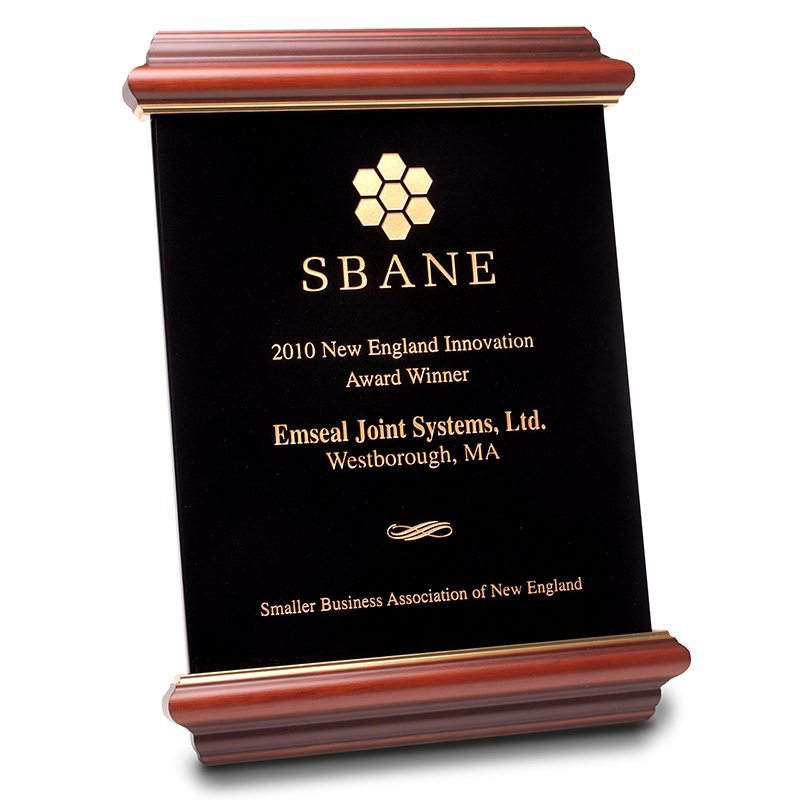
SBANE 2010 Innovation Awards Winner:
The innovation represented in the EMSHIELD family of products, earned EMSEAL a nomination as a candidate for the 2010 SBANE Innovation Awards. From a pool of 162 candidates, EMSEAL was judged a winner and joins Staples, Genzyme, ZipCar and iRobot among other prior winners of this prestigious award.
In addition to the pursuit of breakthrough sealing technologies, EMSEAL actively pursues product improvements, product evolution, process improvements; and standards and performance testing.
The mission of Research and Development is to promote technology innovation that enables EMSEAL to retain its leadership in providing expansion joint sealing and bridging solutions to its marketplace. The R&D engineering staff is united by a core set of professional values and practices. Chief among these are rigorous standards of technical excellence, genuine curiosity, and intellectual integrity.
Activities within the R&D unit include:
- Research
- Product Development
- Product Improvement
- Process Improvement
- Testing
- Performance Validation
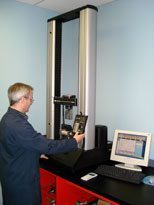
The goal is to continually seek better, more efficient, and more effective ways to manufacture existing products as well as to enhance the performance capabilities of existing products while simultaneously seeking breakthroughs resulting in the creation of new products altogether.
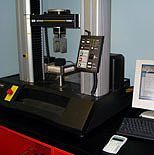
In-house INSTRON capability allows testing and information gathering on material properties.
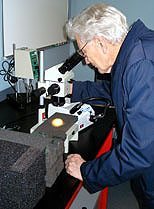
Microscopic observation of various foam types and the relationship of impregnation or saturation options to the cell structure of the foam is an example of ongoing research that informs innovation–most recently the breakthrough release of EMSEAL’s new microsphere-modified acrylic impregnations.
R&D initiatives are managed in a cooperative input environment on EMSEAL’s intranet.
This instrument is a repository for ideas as well as a management tool for tracking tasks and progress on active R&D projects.
Identification of market needs, customer feedback, and employee generated ideas are gathered and logged in the in the same way that paradigm breaking brainstorming based on chemical technology breakthroughs discovered through research by dedicated R&D staff.
Based on market driven performance requirements and demand-urgency, projects are scheduled and given priority.
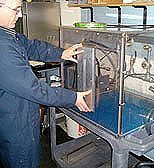
Custom-built testing equipment allows for experimental analysis of foam properties in consideration of variables for achieving watertightness and other performance characteristics in impregnated, open-cell foam sealants.
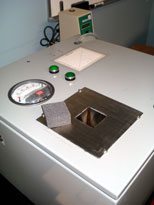
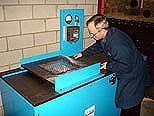
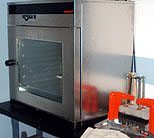
Relating physical property testing to temperature extremes and claimed movement capabilities of any joint sealant material is fundamental in EMSEAL’s research and testing. Using scientific ovens, the Instron, and various water and air pressure test chambers EMSEAL ensures that its materials will not bleed at temperatures and compression levels likely to be achieved in actual field conditions, will self-recover after the heating and compression cycle, and will then resist wind-driven rain.
Active and completed R&D projects include:
- Design of Experiment (DOE) to simultaneously study and evaluate multiple variables in open cell foams considered as possible key contributors to achieving watertightness and other critical performance requirements.
- Exploration of alternative chemicals for enhancement of watertightness in impregnated foam sealants.
- Comparison of compression set characteristics of varieties of closed versus open cell foams under simulated achievable field conditions.
- Comparison of tendency to bleed in wax, asphalt, or other chemicals compared to acrylic based and other alternative impregnation chemistries under simulated field conditions.
- Analysis of ability of silicone-coated, high-movement hybrids to handle racking (shear) and other movements.
- Comparison of force to compress as well as active backpressure of impregnated versus saturated open-cell foam alternatives.
- Development of an improved system for bridging and sealing large and seismic expansion joints.
- Development of an improved system for joint-face-adhered treatment of horizontal-plane expansion joints.
- Development of non-chlorine based fire retardants for incorporation into impregnated foam sealants.
- Development of improved extrusions for blockout-mounted deck expansion joints to eliminate flange-wave and to enhance labyrinth sealing.
- Validation of hybrid sealants ability to withstand extreme hurricane-strength wind forces.
- Development of improved mounting adhesives for assembly-line processing OEM applications.
- Finite Element Analysis (FEA) of the stresses induced by a vehicles skidding across the coverplate of seismic joint system.
- FEA of stresses induced in seismic joint system by point loads of wheels of loaded forklift.