



R-Value of Sika Emseal Precompressed Foam Wall Joint Sealants
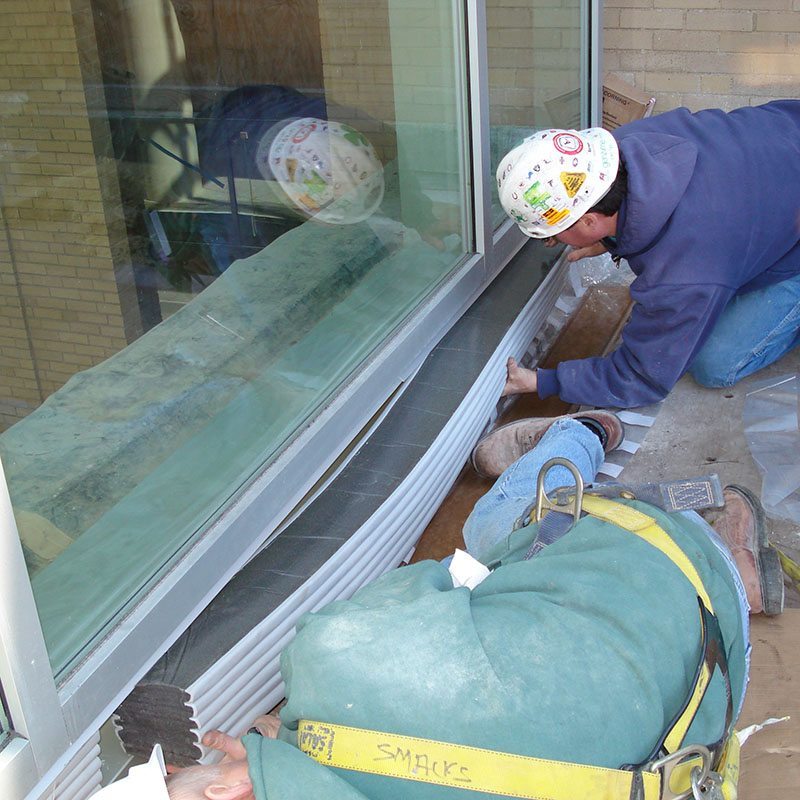
MIT (Massachusetts Institute of Technology), in their award-winning PDSI (Physics, Department of Materials Science and Engineering, Spectroscopy and Infrastructure) building, used SEISMIC COLORSEAL-DS to seal both the inner and outer faces of the window wall systems. In this application the 5 3/4-inch deep material can be expected to impart an R-value approaching R-14 at the window perimeters.
Expansion joints are literally a gap through the insulation of a building envelope. Your choice of technology to fill and seal the gap can set the R-Value of the building assembly.
Is Expansion Joint and Sealant Selection Costing Your Client a Fortune?
Thermal rating of structural expansion joint seals is seldom among product selection criteria. Yet the product chosen to seal large structural expansion joint gaps could be setting the R-value for your entire exterior wall system.
This is because, as was pointed out in “Exterior Wall Systems, R-Value, and Revenue” by Tom Kuckhahn published in the September 2003 Construction Specifier, heat “seeks the path of least resistance, so the R-value of an actual wall is closer to the R-value of the least insulating portion of that wall.”
Kuckhahn continues, “Energy is one of the most significant expenses for commercial facilities, particularly for heating and cooling, which represent about 32 percent of a building’s operating budget.” This means that designers concerned with sustainable, green, or simply efficient design should make energy use their top priority in material selection.
R-Values of Emseal Precompressed Hybrid Expansion Joint Sealants
Tested in 2009 in accordance with ASTM C518-04 “Standard Test Method for Steady-State Thermal Transmission Properties by Means of the Heat Flow Meter Apparatus”.
All values in US units converted to SI units using: 1 K·m²/W = 5.678263 h·ft²·°F/Btu
| Product | R-Value per 1-inch (25mm) of Depthh·ft²·°F/Btu (K·m²/W) | R-Value at Standard Depth One Side of Wall 2-inch (50mm) Nominal Material at Mean Temperature Joint Width | R-Value at Custom Depth 4-inches (100mm) | R-Value 2-inch (50mm) Nominal Material with Standard Depth Both Sides of Wall* | Test Report |
| BACKERSEAL | 1.8 (10.2) | 4.5 | 7.4 | 10+ | .htm |
| SEISMIC COLORSEAL | 2.15 (12.2) | 5.375 | 8.6 | 11+ | .htm |
| WFR2 | 1.03 (5.84) | 4.12 | 4.12 | 9+ | .htm |
| SEISMIC COLORSEAL-DS | 2.25* (12.77) | 5.625* | 9.0* | 12+ | * |
| QUIETJOINT | 2.848 (16.17) | 5.696 | 11.39 | 11.39+ |
*Extrapolated from tests of similarly constituted products–individual tests pending.
Notes: The R-Value of the uncompressed base foam of which Seismic Colorseal and Backerseal are comprised is R-3.28/inch of depth. As density increases R-value decreases. As layers of uncompressed foam are compressed to form the supplied product, the resulting R-values are as stated in the table above.
R-value would fluctuate up and down slightly from this value depending on movement at the joint caused by thermal cycling. The R-value would decrease in summer when the joints close up. In contrast, R-value would increase in winter when the joints open thereby lowering the foam density of the material in question.
Among the choices for structural expansion joint sealing in walls are strip seals and pre-coated, pre-compressed, impregnated hybrid foam sealants.
Strip Seal Expansion Joints
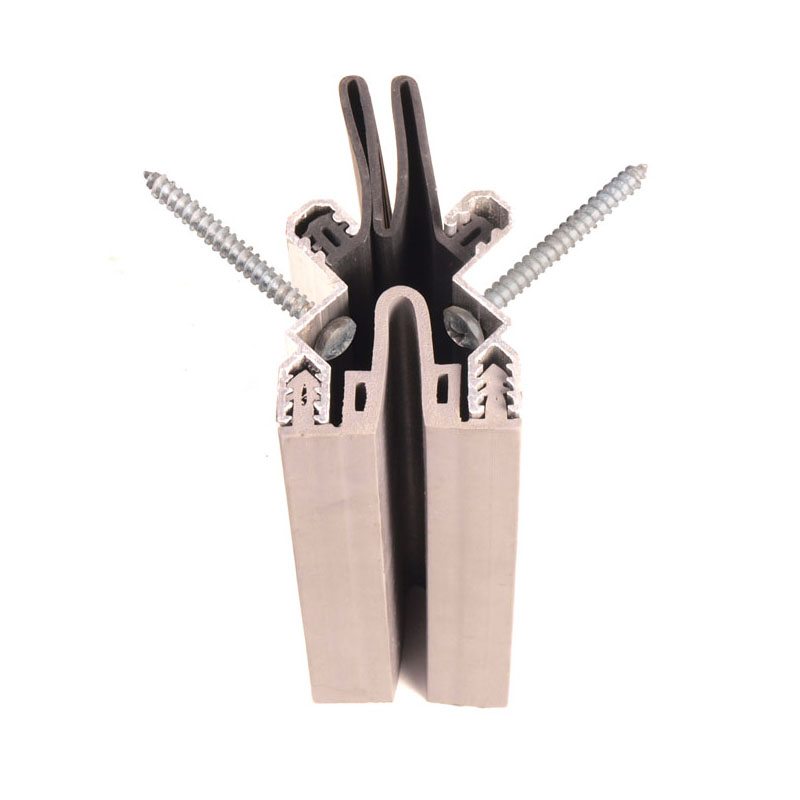
“Strip Seals” are metal (usually aluminum) rails, mechanically anchored to joint substrates into which are snapped rubber bellows sealing glands.
Strip Seals violate good thermal design in a number of ways.
First, the thin rubber bellows impart little in the way of thermal insulation.
Second, the metal rails create thermal bridges in the wall system in the same way that wall ties and other non-insulated conductive materials do.
Precompressed Hybrid Expansion Joint Sealants
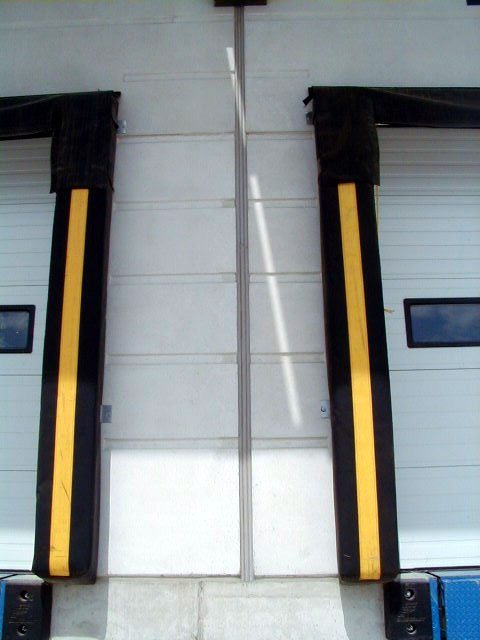
Silicone-Coated, Pre-compressed, Impregnated Foam Sealant (Seismic Colorseal by Sika Emseal) is an open-cell polyurethane foam, impregnated with water-based acrylic sealant, and factory coated with low modulus silicone to create a movement bellows.
In contrast to strip seals, Seismic Colorseal is an excellent insulator.
The R-value of Seismic Colorseal is 2.15 per inch of depth.
This means that on a typical 3-inch joint, the R-value at the structural joint gap of a wall sealed with Seismic Colorseal is:
2.15 x 3.5 (the depth of seal of 3-inch Seismic Colorseal) = R-7.52.
Installed on both sides of the wall, this value will double to R-15.04 excluding the R-value of the air-space created between the two pieces of Seismic Colorseal.
Design flexibility is further extended through the option to customize the depth. With each additional inch of depth, you are adding more insulation.
And, double-sided Seismic Colorseal provides the option to seal both faces of a wall system in a single step.
Finally, because Seismic Colorseal contains no metal and attaches to substrates without invasive metal anchors, it does not create any conductive thermal bridges in the wall system.
And now with the advent of Emshield WFR2 and DFR2, not only can you seal and insulate the building, but you get a UL certified product with UL 2079 2-hour fire rating all-in-one.
As Kuchahn rightly observes, “decisions made during design and construction stages affect the cost and performance of buildings for decades to come-especially in terms of energy consumption.”
It seems to make sense then, that independent-lab-certified thermal rating be among the criteria for specification and acceptance of structural joint sealing materials.
John Ruskin, a nineteenth-century commentator on architecture among other things warned:
“It is unwise to pay too much, but it’s worse to pay too little. When you pay too much you lose a little money—that is all. When you pay too little you sometimes lose everything, because the thing you bought was incapable of doing the things it was bought to do. The common law of business balance prohibits paying a little and getting a lot. It can’t be done. If you deal with the lowest bidder, it is well to add something for the risk you run, and if you do that you will have enough to pay for something better.”