



Non-Invasive Anchoring of Building Expansion Joints
Non-invasive anchoring refers to the attachment of an expansion joint system to the joint faces or substrates to be sealed without the use of any fasteners that are required to be screwed into or embedded in the substrate.
Invasive anchoring on Sika Emseal’s joint systems is eliminated in favor of the use of the mechanical backpressure of precompressed foam, combined with a pressure-sensitive adhesive impregnation and in some cases a field application of a high-bond epoxy adhesive. The result is that substrates are not violated, be they window mullions, bricks, masonry, historic materials, or even jumbotrons or other sensitive equipment.
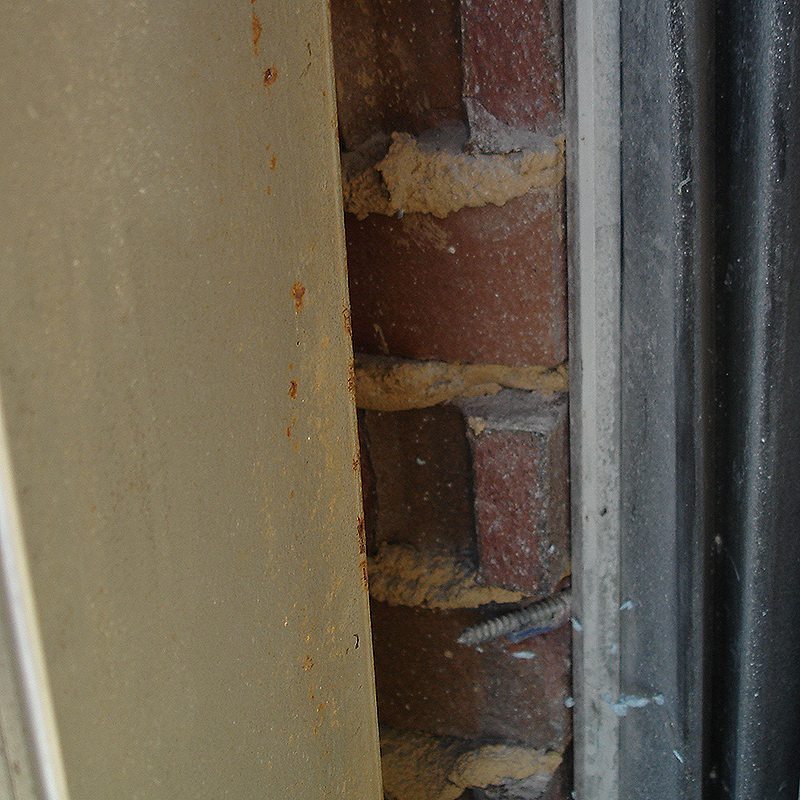
Back of mounting rail of strip seal shows brick spalled by anchoring screw
Screws and expansion anchors are commonly used to fasten rails, plates, and other systems offered for expansion joint sealing and bridging. By nature, screws are either self-tapping or require holes to be drilled and then the screws tapped into the holes. On brittle substrates like concrete, masonry or brick, drilling often results in spalling of the substrates and improper grip. Usually installed at an angle to the face of the joint substrate, the act of screwing is often imprecise resulting in further substrate damage, shearing of the fasteners and loose attachment of the joint system.
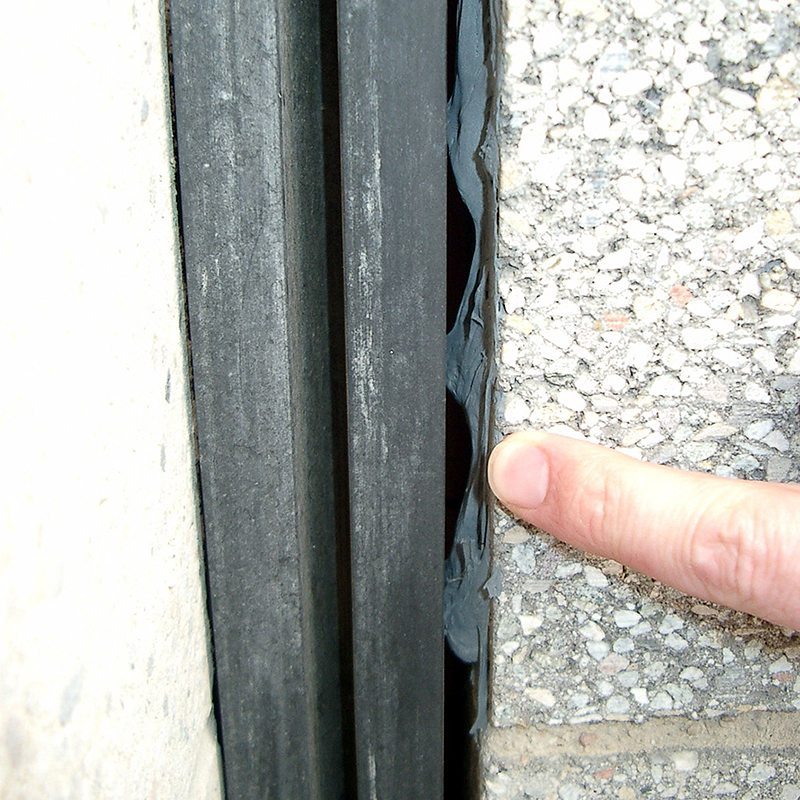
In corner where adjacent wall prevents drilling and screwing, contractor must rely on adhesive instead of screws to hold strip seal in place.
At inside corner applications, common in building additions or plane changes, it is impossible to position a drill or driver to install anchors in the substrate opposite the inside corner. This often-overlooked condition results in the joint system being installed into an unreliable adhesive or not anchored at all.
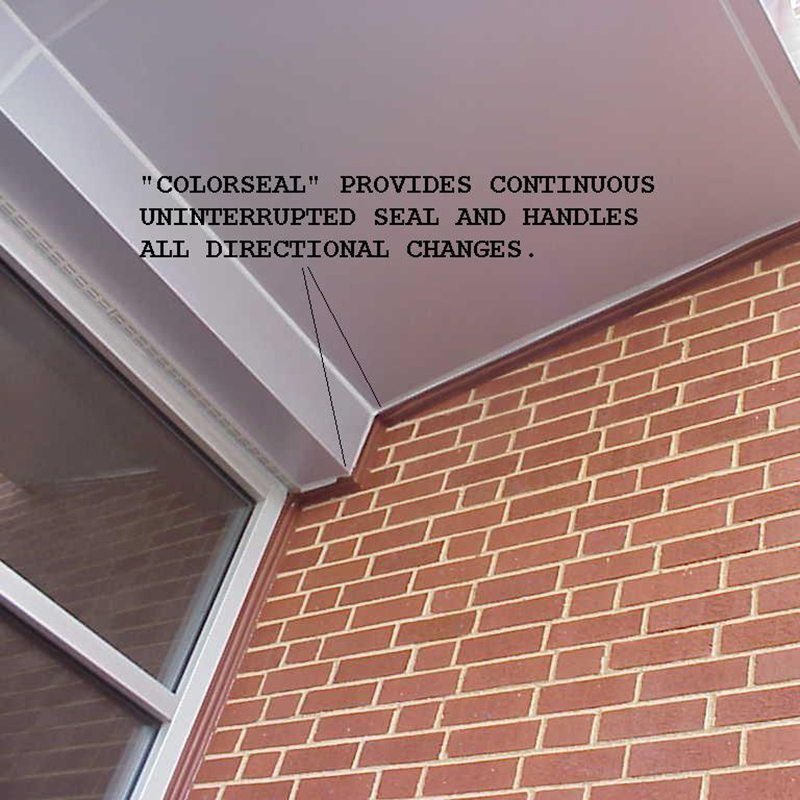
Non-invasively anchored precompressed sealant at curtainwall to brick inside corner plane change
In window or curtain wall mullions, screws violate the mullions and can compromise the waterproofing principles inherent in the mullion design. In any substrate metal fasteners introduce thermal bridges that lower or compromise the insulation value of the wall. Sika Emseal systems for wall expansion joints that feature non-invasive anchoring include: Seismic Colorseal, and Seismic Colorseal-DS.
In horizontal plane deck applications, anchors into concrete to secure cover plates are rapidly deteriorated by impact shocks of traffic. They are also stressed by differential vertical deflection across expansion joints as the result of transient traffic loads. Finally, anchors into the edges of concrete decks can induce a fault-line of pressure that weakens the concrete’s strength and can result in spalling of the joint edge. Sika Emseal systems for deck expansion joints that feature non-invasive anchoring include: SJS System, SJS-FR, DSM System, Emshield DFR2, DFR3, SecuritySeal SSF2, SSF3, and Horizontal Colorseal.
Metal Cover Plate Expansion Joint Covers
Metal cover plate systems are widely used in wall and deck applications for interior and exterior use. They are invasively anchored (screwed into the substrate) to one side of the joint opening. They offer no waterproofing, nor any thermal resistance–in fact, in exterior wall applications, the screws act as a thermal bridge. In all cases, under conditions of differential deflection movement (the two sides of the joint moving away from each other) stress in imparted to the substrate that can cause substrate damage. This is particularly prevalent in horizontal-plane deck applications such as in parking structures and stadium concourses where the screws are anchored into concrete. Differential deflection during load transfer (wheels of a vehicle crossing an expansion joint) the plate will torque against the rigid fastener and either bend the plate, loosen the anchor, crack or spall the concrete–or all three.
Sika Emseal uses cover plates as part of one of its precompressed, impregnated foam and cover plate systems (SJS System). In this case the cover plate is anchored to a central spline that is supported by non-invasively anchored precompressed, impregnate foam. No mechanical embedments, screws, or other fasteners contact the concrete substrates. Not only is cover plate non-invasively anchored, the system’s additional benefits are that it is watertight at the deck surface (eliminating the need for water management in looped membranes or gutters); is traffic durable; and quiet when installed with a sound and impact-absorbing nosing material like Emcrete.
NOTE: The definitions of terms and terminology herein are rooted in the context of use in the field of construction-related joint sealing in Sika Emseal’s experience. They are provided with the intent of offering a fuller understanding of the context of their usage. Any suggestions or questions regarding interpretation are welcome and should be directed to Sika Emseal. Thank you.