




“Integral-Nosing-And-Gland” Joint Systems Can’t Handle Three-Dimensional Movement Demands
An engineer at a firm with which we have shared over 26 years of watertight expansion joint success, was tempted by a “new” technology as an alternate to EMSEAL Thermaflex for parking deck joints.
He sent an email asking if we would be able to come up with something similar. Here are his reasons for considering the joint:
“We found a new joint that does not need the nosing materials and the gland wings are 3/4” thick. I think it is a great idea and could prevent cracking of the nosing and it looks much better.”
In short we see no advantages of this system over a conservatively aggregate-loaded membrane/nosing system like Thermaflex, and have observed critical shortcomings in respect to the ability to ensure watertightness at splices and at joins in changes in plane and direction.
Here is our complete response:
The concept of a system involving integral nosing blocks and gland has been explored for years and by us in the early 1990’s. EMSEAL chose not to introduce our prototypes to market because this concept falls short in respect to installation practicality, limitations on shipping lengths (requiring excessive joining), and the mutually-exclusive desires to have a material that can be heat welded to ensure continuity of seal through expansion joint transitions at plane and direction changes and at terminations AND that adheres in a watertight fashion to blockouts.
These systems fail to consider many of the key requirements for waterproofing success in this system.
We have had many discussions on the differences between thermoset and thermoplastic rubber. The advantages of thermoset rubbers have diminished significantly over the decades since the 1940’s when they were a breakthrough technology. Over time EPDM has fallen out of favor particularly in waterproofing applications. I’m sure you are aware that as a flashing material for liquid-membrane roofing and waterproofing, EPDM has long ago been replaced with other alternatives. This is because migration of processing oils can cause bond failure between the EPDM and dissimilar materials. Where EPDM is still used in single-ply roofing applications, a 8-12 inch overlapped splice using a pliant, rubber-cement, in shear, is required to make a bond between flat sheets.
The reason for the choice of EPDM by this expansion joint manufacturer, it can be assumed, is because more advanced thermoplastic rubber (like Santoprene) does not bond aggressively to epoxy or other adhesives. This “block” system is dependent on a glue bond to the blockout and thus a thermoset rubber had to be used.
Unfortunately, this means that heat-weldability has been sacrificed. It is heat weldability that has provided the cornerstone of our mutual success with EMSEAL’s Thermaflex system. It is at changes in plane and direction that expansion joints leak. An EPDM system must be glued at these conditions. Glue, under the stresses of joint opening, closing, undulation, and elongation and compression through thermal cycles does not hold up. The rapid decrease in the popularity of inflated-seal systems is a graphic illustration of the limitations of thermoset-rubber based expansion joint systems.
By contrast, the ability with Thermaflex to provide as long as 500 foot runs without joining and then the ability to heat-weld and reinforce joins at transitions in terminations further underscores the shortcoming of the EPDM-based system.
It is unlikely that glue applied for the purpose of joining the tiny cell sections of the gland-portion of this extrusion will hold over time and under the stresses of joint movement.
In our seminars and presentations we caution designers against the evaluation of materials from cross-section details only. We caution ourselves and our competitors against designing in cross-section. Any one can sketch in cross-section a system that looks watertight. It is in axonometric and three dimensions however, where the rubber hits the road and leaks will occur.
Against the back drop of EMSEAL’s incredibly long track record of success over years with the Thermaflex system there is little reason to jump to at a “new” old technology. If appearance is the other driver, the extruded block may have somewhat cleaner lines, but in the end the caulk bead and black strip of rubber is not going to look much different to the user than the Thermaflex system and ultimately of what importance is aesthetic if the joint leaks?
With published installation tolerances of 1/16-inch, we suspect that this system will result in a more expensive installation up front, and will likely not provide the minimum five years of waterproofing performance you would expect, not to mention achieve the ten-plus years of trouble-free joint sealing that many of your clients using Thermaflex have enjoyed.
We respectfully request that you consider this technology with healthy engineering skepticism and at minimum conduct a performance trial for five years of observation before embracing it more widely.
We look forward to the opportunity to discuss this and other issues related to the state-of-the-art in joint sealing design philosophy and technology.
Thank you for your consideration and continued support of EMSEAL’s products. As we move forward, one satisfied building owner at a time, we find validation in our approach and in the words of a nineteenth century observer of society and the construction arts, John Ruskin:
“It is unwise to pay too much, but it’s worse to pay too little. When you pay too much you lose a little money—that is all. When you pay too little you sometimes lose everything, because the thing you bought was incapable of doing the things it was bought to do. The common law of business balance prohibits paying a little and getting a lot. It can’t be done. If you deal with the lowest bidder, it is well to add something for the risk you run, and if you do that you will have enough to pay for something better.”
To give us feedback on this or any other topic on our website please feel free to call 508-836-0280 or email techinfo@emseal.com.
Joints in Decks are Rarely Straight. Joint will leak at changes in plane and direction and at terminations unless they are designed not to:

Glued transitions in thermoset rubber systems, under the stresses of joint opening, closing, undulation, and elongation and compression through thermal cycles do not hold up.
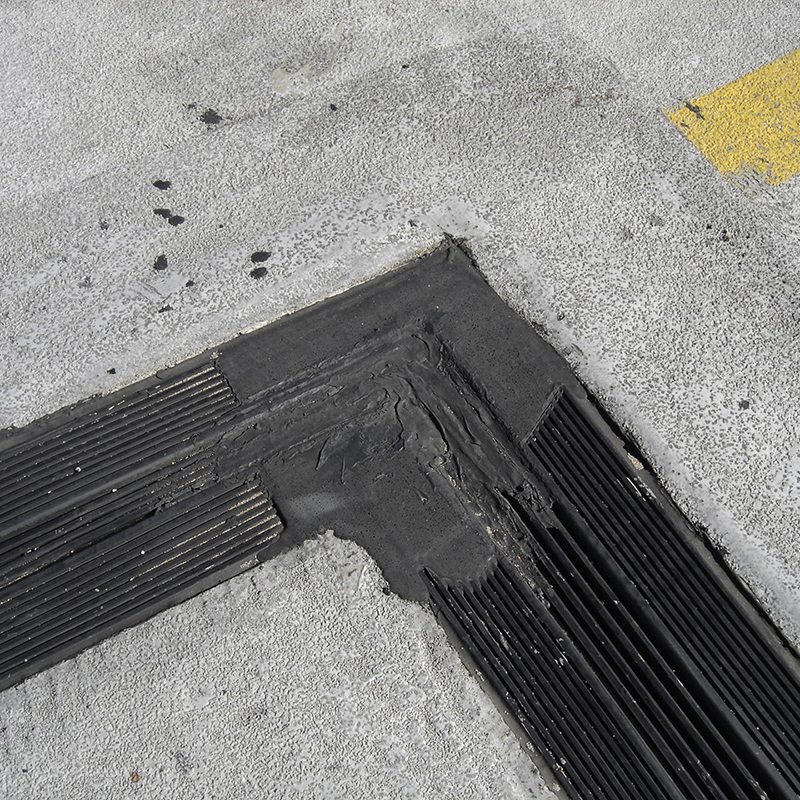
Glued flat-90 degree transitions on this project failed immediately prompting unsuccessful attempts at topical application of caulk to stop leaks. After two years and one complete replacement attempt, this installation was abandoned and retrofit with Thermaflex by EMSEAL featuring warranted factory-welded, transitions–Below:
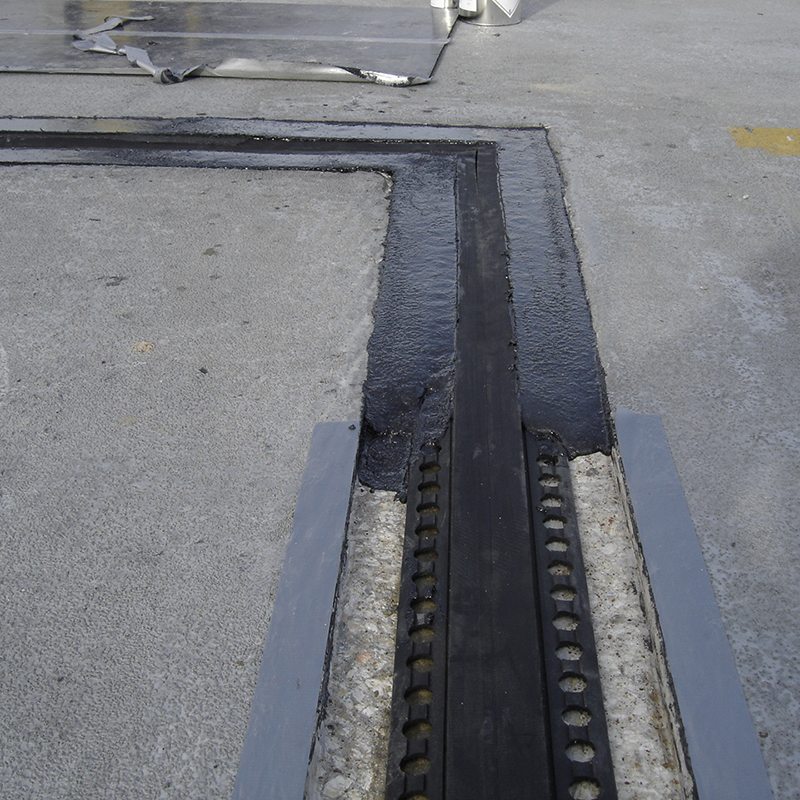
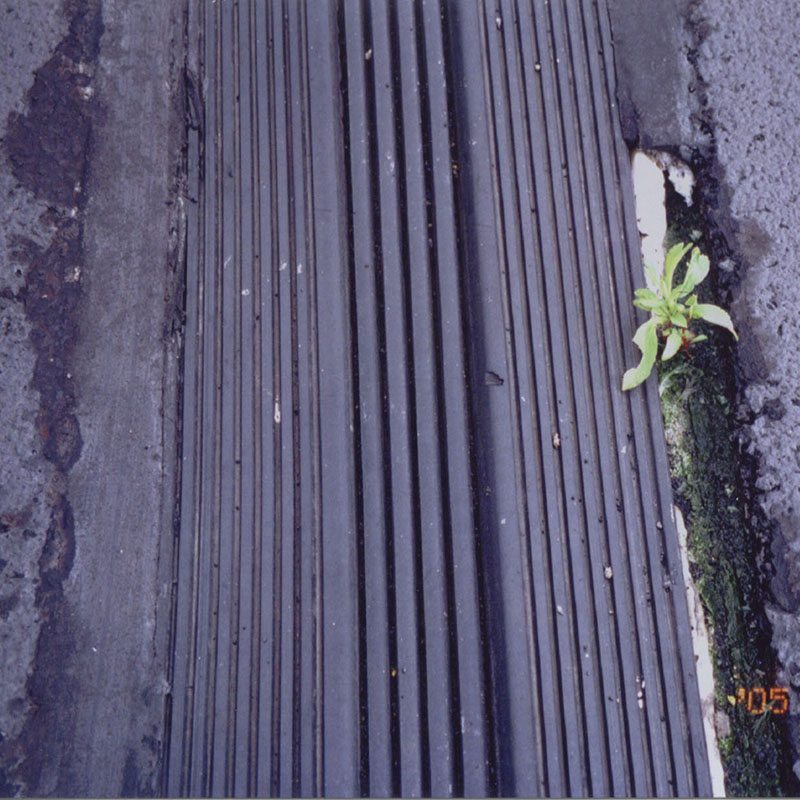
Regardless of how well the blockouts are prepared to receive the extruded nosing blocks, a filler strip of caulk or other material will be required at the back edge. This strip negates any aesthetic gain and inevitably fails resulting in water bypassing the system.
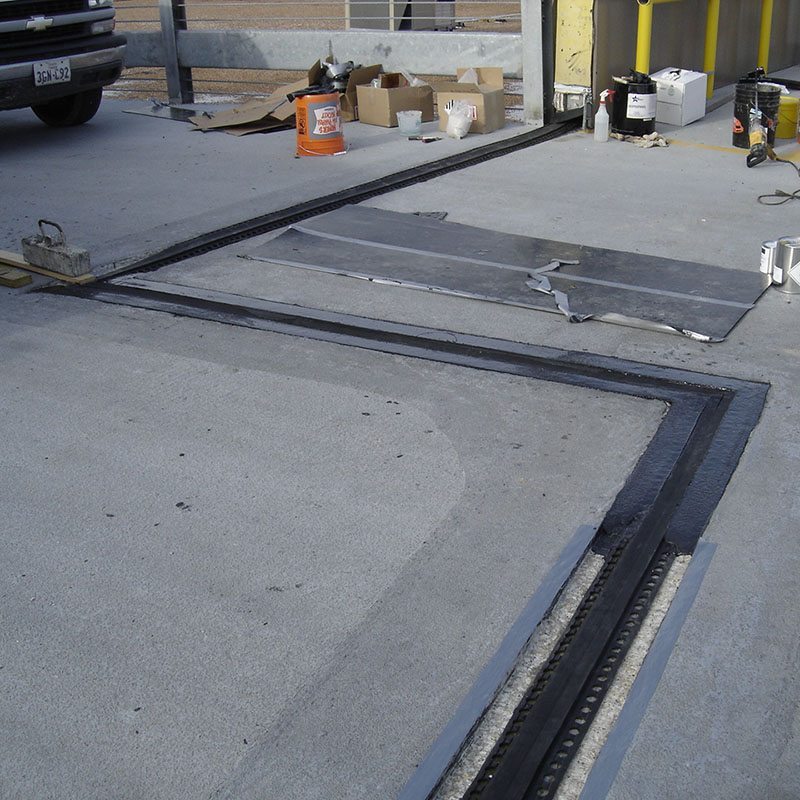
By contrast to the integral nosing and gland systems, EMSEAL’s Thermaflex features heat-welded and reinforced, factory-fabricated transitions to ensure continuity of seal. In addition the conservative aggregate loading in the EMSEAL header ensure that the material flows to repair spalls in the deck while also providing a balance between toughness and flexibility.